DADAO XD®’s DG moment
Recording engineer Zhang Yilong on Xiaofu Ju’s immersive album Mist Without

Contents
What this article covers
5 chapters · About 15 minutes
Interview
In conversation with Zhang Yilong
Xiaofu Ju’s solo piano album Mist Without was released worldwide on July 10, 2026—his first album since signing with DG China. There is something else that makes it unusual: the immersive version uses no artificial reverb. Its sense of space comes entirely from the recording room itself.
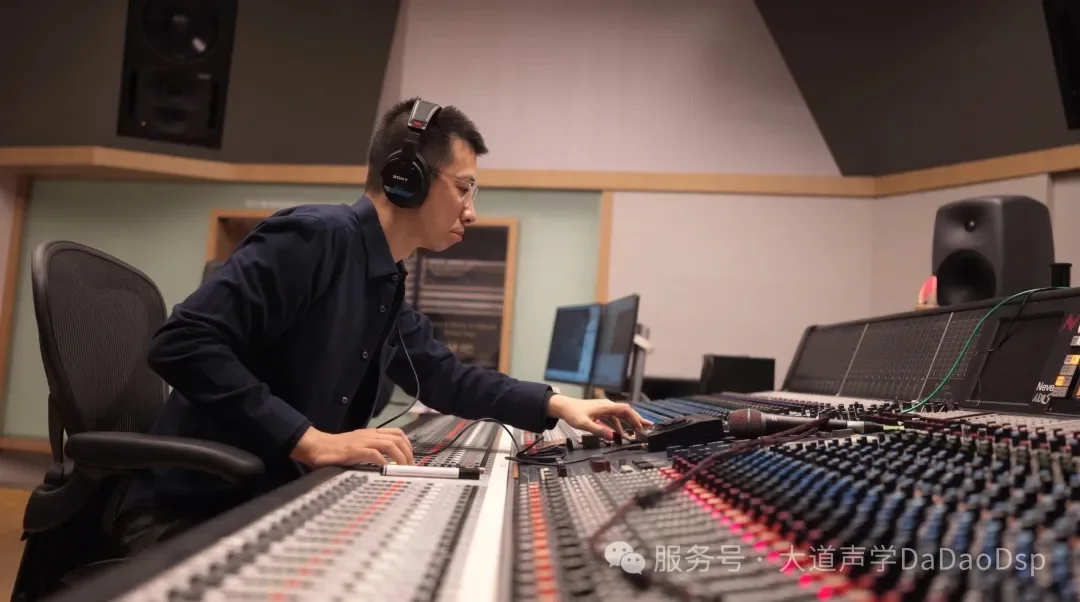
DADAO’s Zhang Wanyi invited the album’s recording engineer, Zhang Yilong—Deputy Head of the Department of Recording Arts at the Communication University of China, doctoral supervisor, and a board member of the Chinese Association of Recording Engineers—for an in-depth conversation about DADAO XD® microphone arrays, recording technique, and his experience of DG’s recording aesthetic.
“The immersive sound relies entirely on the studio’s natural reverberation. I rarely get to that point myself. It was possible because of the repertoire: use this sound for other pieces, and people might not accept it.” — Zhang Yilong
Aesthetics
A salon-era sensibility and the DG China aesthetic
Q · How involved was Xiaofu Ju in shaping the recorded sound? With death as the album’s theme, did the artist establish the direction first, or did you translate that idea into technical choices?
A · From the outset, this was conceived as a native immersive album. The works all revolve around death: different composers and periods, but that same dark theme. Our initial thinking matched the artist’s team. For a studio album, we did not want the beautiful, conventional sound of a nine-foot Steinway in a concert hall. Technically, we were deliberately working against that aesthetic.
The previous album was recorded in an empty concert hall at the Beijing Performing Arts Centre, so the conditions were different. This time, we decided on a studio from the beginning and eventually chose the music recording studio at Beijing Film Academy. It is not a large room, but it has a distinctive character: an audible reverberant tail and a recognizable sense of space that suited this album.
Q · When working with DG, the biggest pressure may come from delivery specifications rather than taste: loudness, the mastering chain, ADM downmixes, and reliable playback. What did you need to plan for at the recording stage to meet those requirements later?
A · I only communicated with the person handling DG’s quality control by email. I imagine he has a very precise monitoring system, and he is clearly experienced. The specification sheet was extremely detailed: loudness requirements, maximum values, average loudness, and downmix specifications for ADM delivery—much more detailed than stereo.
I delivered three versions in total. Communication was straightforward; nothing came back as unusable. Every comment concerned a specific point that could be adjusted. We adopted some suggestions and did not adopt others. To me, DG’s recording aesthetic is about a coherent tonal character and overall balance, though every engineer may interpret that differently. The essential point is that their technical delivery requirements are at the highest international level. Merely acceptable is not enough.
Recording
Recording solo piano with a DADAO XD® immersive array
Q · There are many established immersive microphone arrays. Did you use a particular format for this session, or was the setup shaped by your own preferences?
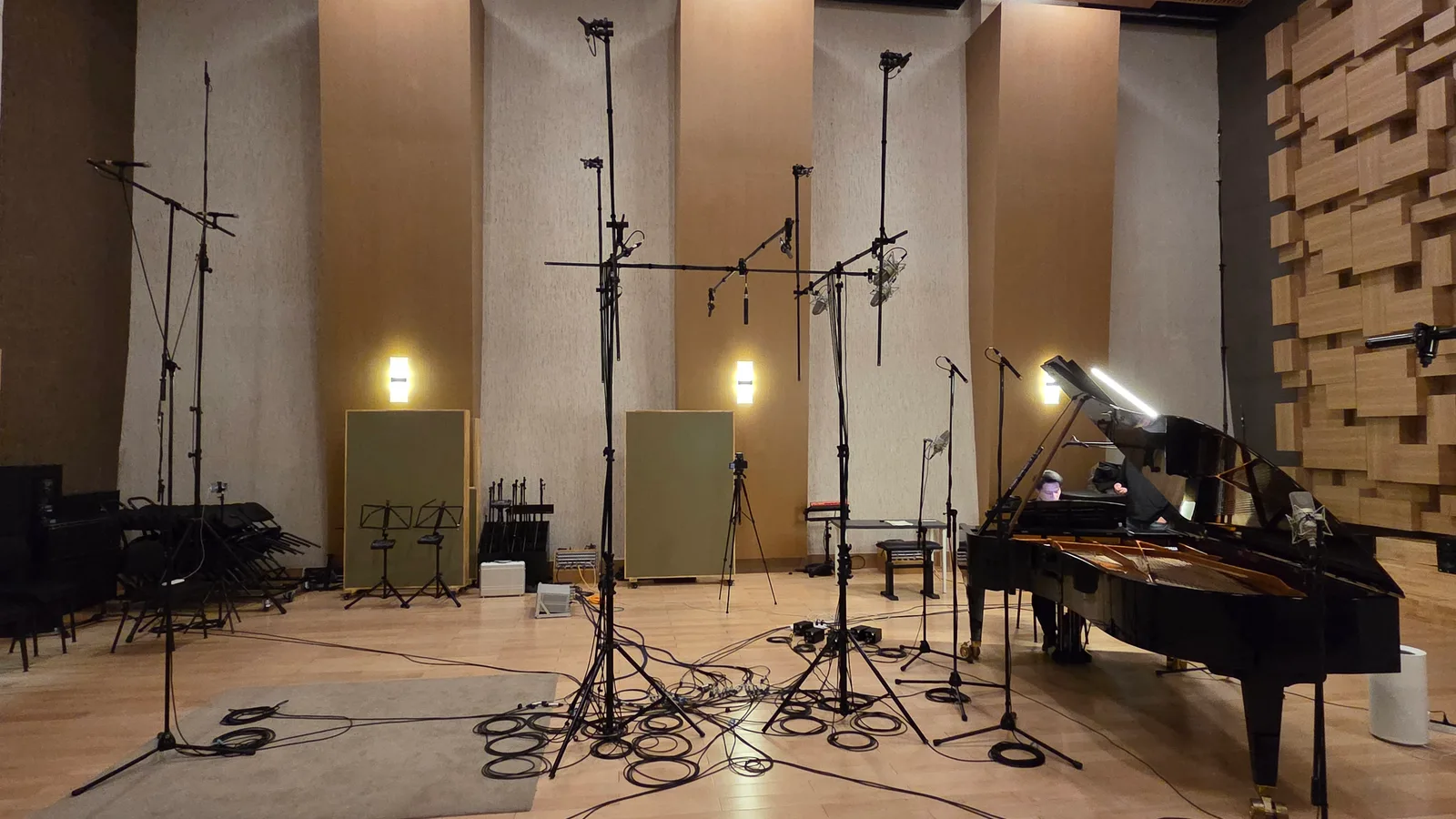
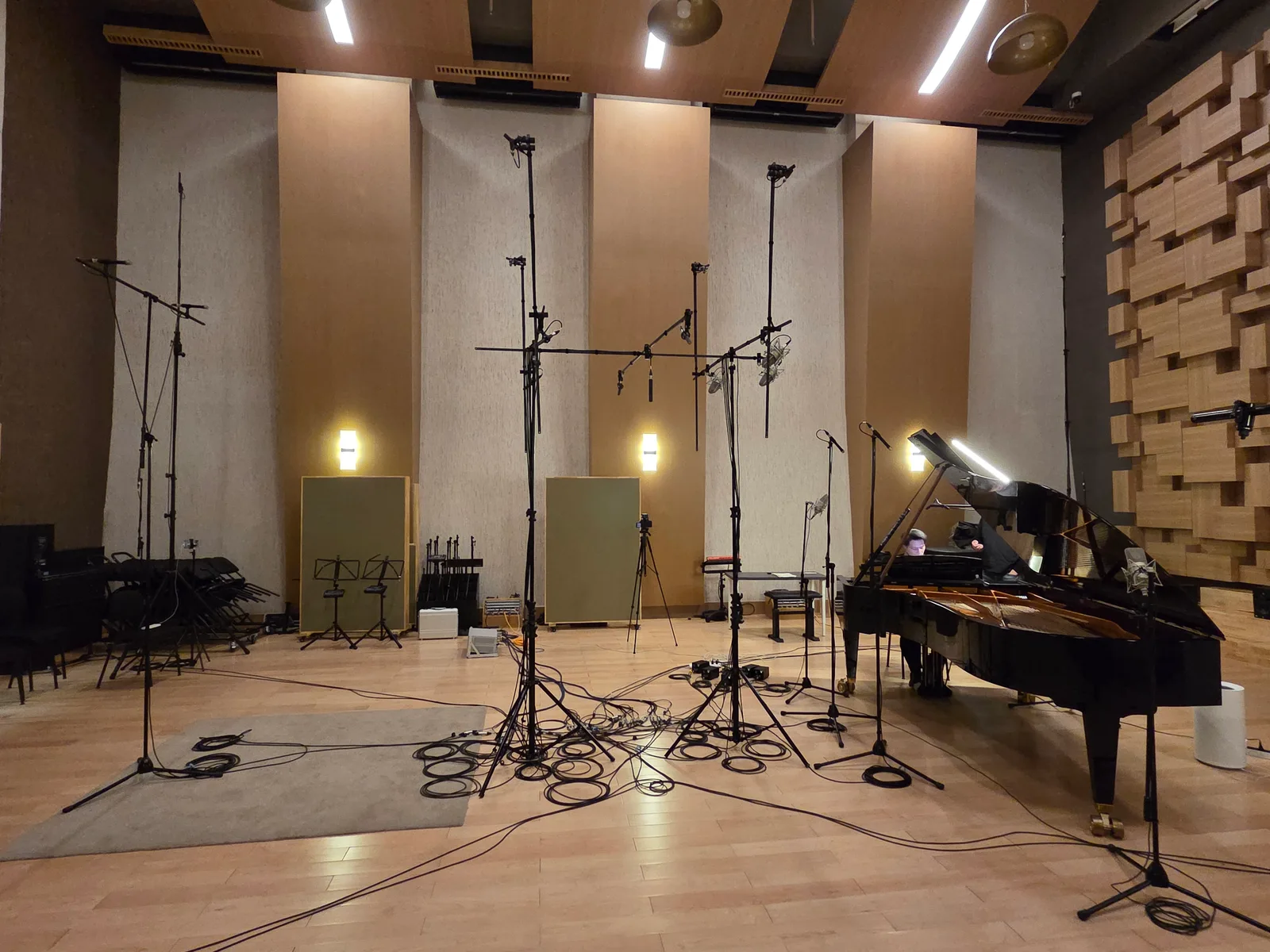
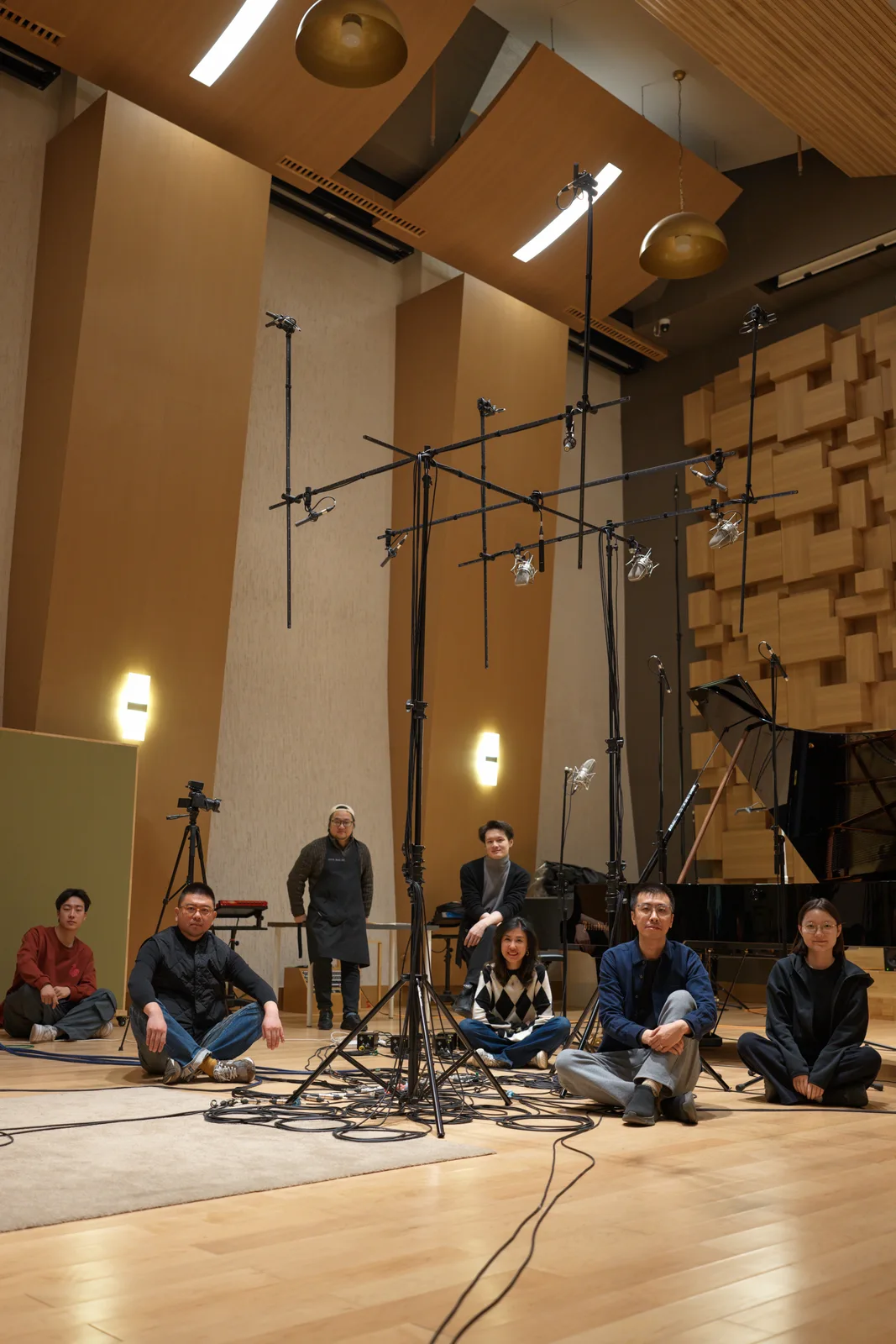
A · We used DADAO XD® bars to build a two-level cube. The lower level used eight omnidirectional microphones as a 7.1 surround array. For the upper level, we placed two sets of microphones—one omnidirectional and one cardioid—in nearby positions for A/B listening. If you have enough channels, record more and leave yourself options in post.
The three front microphones in the upper omnidirectional set were Neumann M150s, with their spherical diaphragm design. The centre microphone extended slightly forward, and the three were not strictly level. The piano was also slightly angled, roughly parallel to those three microphones. We turned the array a little relative to the room as well. The room is symmetrical, and the stand was in the middle, so I was concerned about an acoustically unfavourable result if everything was perfectly square. The piano and array remained aligned with each other, though: their geometry was consistent, so the imaging would not be disrupted.
We also set up two groups of ambience microphones. One used omnidirectional microphones farther away, at the room’s four corners. The other used figure-eight microphones with their null axes—the 90-degree sides—pointing toward the source and their main axes facing the side walls. In an immersive mix, these capture local room ambience.
◆ Lower 7.1 horizontal array · We used 2-metre XD® bars, with the microphones balanced on either side. The setup is much lighter than K&M, so moving microphones is easy. With the scales, moving each side inward by 5 centimetres takes no time. I monitored in the final 7.1.4 format on site, so I could adjust anything I heard immediately.
◆ Upper four-microphone height array · We used 1.5-metre bars, about another metre above the lower level. The line extending from the piano lid sloped slightly downward. The lower level was more than 3 metres high, with the upper level roughly a metre above it. The studio’s clear height is around 9–10 metres or more. That is unusually tall relative to its floor area, but it gave us enough vertical space for immersive recording.
◆ The .1 in 7.1.4: LFE · We did not use it in the final mix. The low end was beautiful, but the piano did not go so low that it needed help from a subwoofer. For most playback systems, keeping as much of the programme as possible in the full-range channels gives better compatibility.
Q · What does consistency in your recording tools mean to you? Do you change setups for each project, or use a familiar workflow across different repertoire, including stereo?
A · Yes, I use it for stereo too. A couple of days ago, I was not recording immersive audio, and I still put a 1.5-metre bar in front of the piano: one bar, one ordinary stand, and left, centre, and right microphones. Leave the centre fixed and adjust the spacing of the outer two, and you can record the piano. Previously that meant three stands, each adjusted separately. Now one stand does it. It is convenient and looks tidier. With DADAO, the main advantage is the low weight. These bars travel with me; they are not fixed studio equipment. I have about ten of your 2-metre and 1.5-metre bars. I can bundle them together and carry them on my own, and the whole lot weighs less than a single K&M microphone stand.
Post-production
Post-production: pedals, dynamics, and artistic judgment
Q · The balance of the immersive microphones is more than an acoustic decision: it shapes the emotional intensity of the album. How did you choose between the clarity of multiple microphones and the intimacy of a single microphone?
A · We used different microphones and balances for each piece. Some pieces did not use a particular set at all; others did. The album has a fairly consistent overall character, but there are still differences between the works. Even with the same array, the faders are in different positions for every piece. These are expressive and emotional choices. There is no entirely rational explanation; you simply feel that a piece should sound that way.
Q · Where were the strictest constraints in DG’s immersive mastering requirements: loudness limits, spatial precision, or phase consistency in ADM downmixes? Do you plan for them while recording, or leave them to the mastering engineer?
A · Immersive delivery comes with a very detailed list: loudness requirements, maximum values, average loudness, and downmix specifications for the ADM file. It is very specific, with quite a few requirements. Stereo had fewer special requirements; it is such a mature format, with broadly established expectations worldwide. Across the three delivery rounds, he also made requests and suggestions about the sound quality. We adopted some and did not adopt others.
Q · Could you explain the pedal editing in more detail? Did you decide how much to reduce by listening, or did you use a numerical threshold?
A · The pedals. We recorded their sound too, and this piano’s pedals were quite loud. Post-production was extremely involved: I manually edited every pedal event. I controlled how far to take each one, because the pedal sound had to remain. It was not a creaking noise; it was the normal sound of changing the pedal and controlling sustain. It sounds a little like the noise floor briefly rising. Someone unfamiliar with it might mistake it for equipment noise, but it is the pedal. Almost every piano recording faces this issue. DG felt it needed more control, so I went through everything manually—first stereo, then immersive. Two separate passes. It was a lot of work, and very painful.
Initially I wanted to copy the stereo edits across. I had taken notes on almost every edit. That did not work. An immersive sound field surrounds you, so it behaves differently from stereo. A 5 dB reduction might work in stereo, while immersive playback could need a reduction in the teens of decibels—or might sound more natural with no reduction at all. There is no strictly linear relationship. I redid the entire process myself.
Q · Choosing not to control the dynamic range is itself a statement. Was the priority the music’s expressive extremes over a loudness that would be easier for everyday playback? What led to that decision?
A · Yes. The album has a very wide dynamic range. I did not deliberately try to make it that wide; the differences between the pieces were already substantial. The pianist plays with great subtlety, yet the loudest moments are very loud. The finished album therefore has a relatively low average loudness, and listeners need to turn the volume up a little. In post, one issue was that quiet passages sounded farther back and less distinct, while very loud passages suddenly came forward—almost hitting you in the face. The image moved back and forth. My instinct was to leave that movement largely alone, because it was part of the expression. Xiaofu told me that when playing these pieces, he imagined extreme scenes such as battling Death. He is a poet; much of that poetic imagery is extreme, and the sound supports it. This is not an everyday scene. DG suggested some dynamic EQ to control the changes in apparent distance, but I largely chose not to use it. Of course, I discussed this thoroughly with the producer and pianist. We tried it; it is a familiar, routine technique for us. In the end, everyone felt the processed version was less satisfying and less exciting.
Instrument
The twenty-year-old Bösendorfer
Q · Bösendorfer pianos are often described as beautiful, balanced, and singing. This twenty-year-old instrument seems quite different. What was your first impression? Was its acoustic character a better match for the album than that of the nine-foot Steinway?
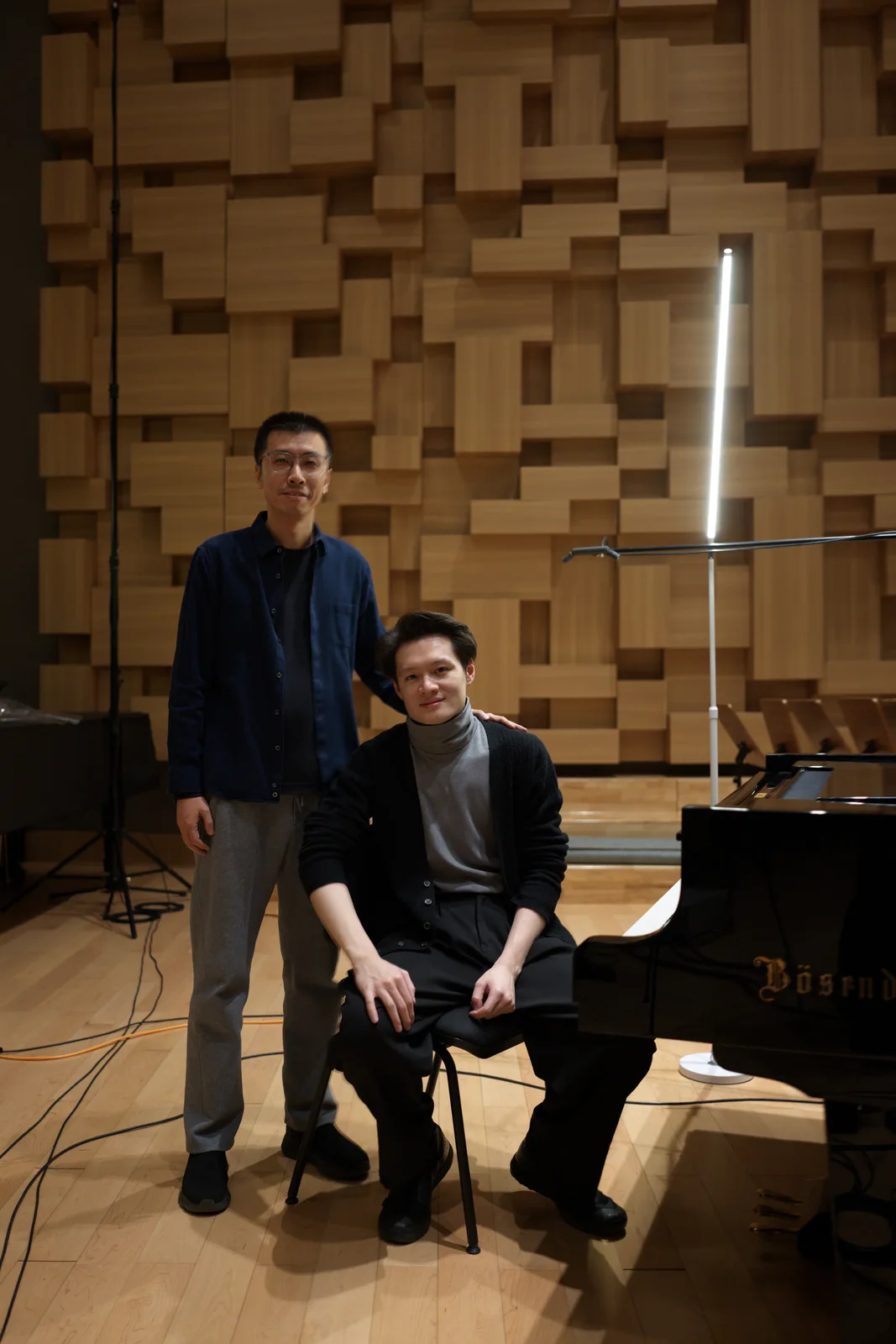
A · He bought a Bösendorfer for this album. Perhaps not solely for the album, but recording it was the first thing he did after buying it. He personally chose a second-hand Model 280 made in 2005. It was the 98th Model 280 built by the company, which was founded in 1828, and it bears the factory marking 280-98. It sounded completely different from the studio’s Steinway, and different from the Bösendorfers I usually encounter. Its low-register dynamics were extraordinary. It could be incredibly loud; you could almost feel the soundboard vibrating, producing that beating sound, as though a single note were moving on its own. Yet it was not muddy. It was fascinating. The pianist was excited too, because it let him make more extreme expressive choices. The high register always had a beautiful, transparent quality, but with a thin veil of mist. The light did not pierce through, yet you could feel and hear it: the tone was rounded. That came from the instrument, not post-processing. Here I used neither reverb nor EQ. I relied entirely on the microphones’ characteristics, their distance, and the room—on acoustics. We had enough time to make adjustments, and immersive monitoring was running on site, so I could listen and change things in real time without DSP. What I played to the artists already conveyed the essential character of the final result.
Q · Finally, what would you say to young people hoping to enter the recording profession?
A · I am not that old myself, so I will not hand out advice! [Laughs.] In general, the technical standard of recording in China is now quite close to the international level, and our thinking is moving forward together. We exchange ideas with international masters every year, both travelling abroad and inviting them here. I do this regularly, and I do not see major differences in specific methods or ideas. Your XD® microphone-array accessories are quite advanced in some respects too. I have not seen similarly lightweight equipment overseas; what I usually see is much heavier.
Related Products · Related products