M/S stereo: decoding two recorded signals into left and right
Record Mid and Side, then derive L/R with a sum-and-difference matrix. The Side level, and therefore the stereo width, can remain adjustable in post.

Contents
What this article covers
6 chapters · About 9 minutes
Comparison
X/Y and M/S differ in when left and right are created
X/Y uses two directional microphones in a coincident or near-coincident arrangement, and the recorded channels normally become left and right directly. M/S instead keeps a forward Mid signal and a sideways figure-eight Side signal. These are not yet L/R and must pass through a decoding matrix before stereo playback. Both methods can place their capsules close together; the main difference is how the sound field is represented and whether width remains adjustable during decoding.[1][3]
Signals
What Mid and Side capture
Mid captures whatever falls within its own polar pattern. A forward-facing cardioid is common, but Mid is not restricted to cardioid. Side is a sideways figure-eight microphone whose two lobes have opposite polarity, providing left-versus-right difference information. Confirm which way the positive Side lobe faces during setup; reversing that convention swaps the decoded left and right channels.[1][2]
Matrix
The decoding matrix: L = M + kS, R = M − kS
When the positive Side lobe faces left, the basic equations are L = M + kS and R = M − kS. The coefficient k is the Side gain and sets its contribution to each output channel.[1] Different decoders may use 0.5, 1/√2, or another normalization to manage output level, so the equations express the sum-and-difference relationship rather than a universal gain structure. To build it manually, route M to both L and R, duplicate S, send one copy left and an inverted copy right, and adjust the two S gains together.
Width
Adjust Side, then check mono
With k at zero, both output channels contain only Mid, producing dual mono. Raising k generally widens the image, while inverting Side swaps the nominal left and right channels. When decoded L/R are summed to mono, Side cancels and only Mid remains; this is the basis of M/S mono compatibility.[2][3] In practice, listen to lateral reflections and monitor correlation as well. Too much Side can create excessive anti-correlation and an unnatural image.
Routing
Routing D-PZM Decoder in a DAW
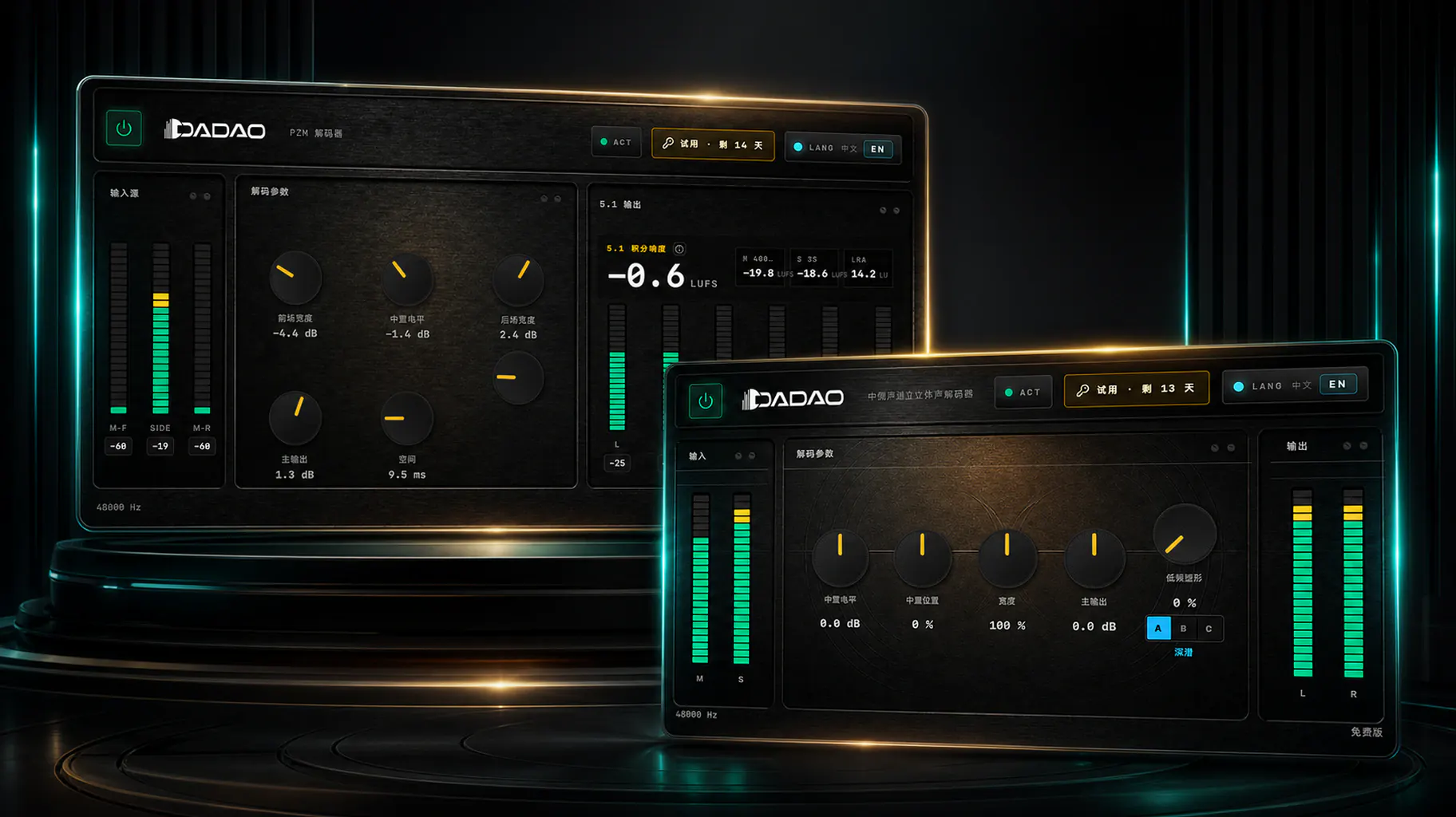
In the DAW, keep M and S as separate mono tracks and route them to a decoding bus with two inputs and two outputs. D-PZM Decoder’s current Stereo mode performs the M/S-to-L/R matrix at this point.[6] Logic, Pro Tools, Nuendo, and other hosts build buses differently, so a universal instruction such as “put it on the Master” would be misleading. Confirm the input order, Side polarity, and output channels before monitoring.
Double M/S
Double M/S: deriving 5.0 from three inputs
Double M/S uses a forward-facing Mid, a sideways figure-eight Side, and a rear-facing Mid, with the three capsules placed as close together as possible. The front Mid and Side form the front M/S pair for L/R, and the front Mid can also provide C. The rear Mid and the same Side form the rear M/S pair for Ls/Rs, so the array itself supplies five full-range channels.[4][5] Current D-PZM Decoder specifications also describe a plugin-generated LFE output, producing a six-channel 5.1 result. LFE is downstream processing, not a sixth signal captured at the microphone array.[6]
References
Sources
Standards, technical documents, and official manufacturer pages checked for this revision.
- 1MS Technique
SCHOEPS · Accessed 2026-08-09
- 2VP88 Stereo Condenser Microphone User Guide
Shure · Accessed 2026-08-09
- 3Common Techniques for Stereo Miking
Shure · Accessed 2026-08-09
- 4Double M/S
SCHOEPS · Accessed 2026-08-09
- 5Double M/S Plug-in
SCHOEPS · Accessed 2026-08-09
- 6D-PZM Decoder Product Specifications
DADAO AUDIO · Accessed 2026-08-09
Related Products · Related products